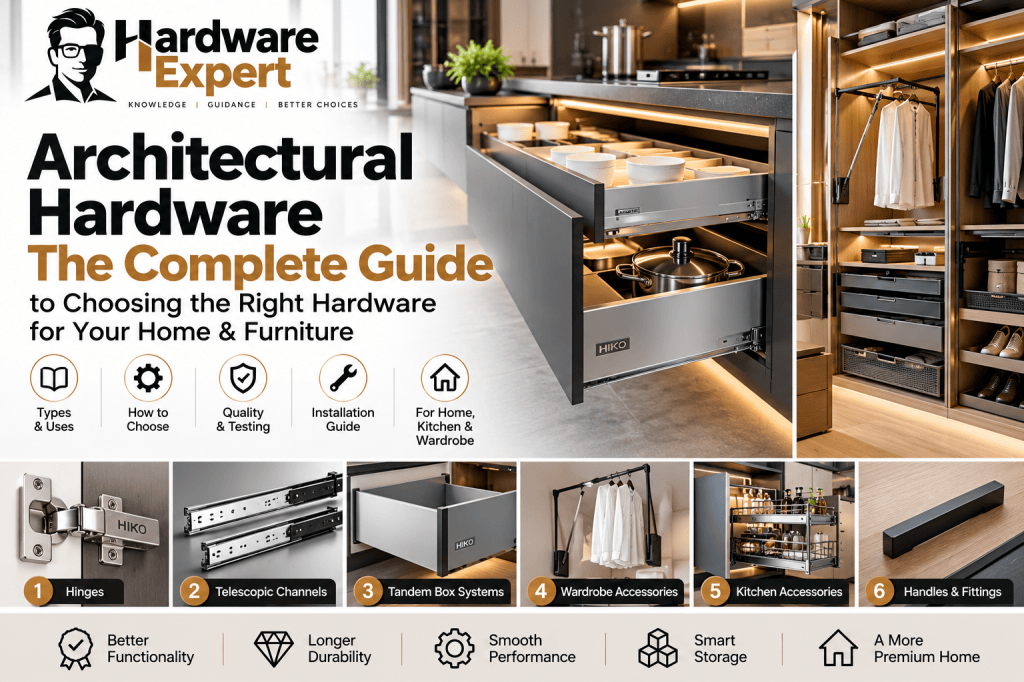
Architectural Hardware: The Complete Guide to Choosing the Right Hardware for Your Home & Furniture
By Hardware Expert
When we talk about a kitchen, wardrobe, modular furniture or modern home interiors, most people notice the design, finish, colour and material first.
But there is another component that quietly determines how well that furniture actually works: hardware.
A beautiful kitchen can become frustrating if drawers don’t operate smoothly. A premium wardrobe can lose its usability if the accessories are poorly selected. Even a high-quality cabinet can develop problems when the hinges, channels or mounting hardware are not suitable for the application.
That is why architectural and furniture hardware deserves more attention.
At Hardware Expert, our objective is to simplify hardware knowledge and help architects, interior designers, furniture manufacturers, dealers, carpenters and homeowners make informed decisions.
What Is Architectural Hardware?
Architectural hardware broadly refers to the functional components used in buildings, furniture, kitchens, wardrobes and interior applications.
Depending on the application, it can include:
- Hinges
- Telescopic channels
- Drawer systems
- Tandem boxes
- Wardrobe accessories
- Kitchen accessories
- Handles and knobs
- Screws and fasteners
- Cabinet fittings
- Pull-down systems
- Basket systems
- Furniture connectors
- Door and cabinet mechanisms
Hardware may look like a small component, but its role is significant.
The right hardware can improve functionality, durability, safety and the overall user experience of furniture.
Why Hardware Selection Matters
Imagine buying a premium wardrobe and installing a drawer that feels rough every time you open it.
Or installing a kitchen basket that doesn’t carry the expected load.
Or choosing a hinge without considering the door weight and usage frequency.
The furniture may look excellent, but the experience will not match the appearance.
This is why hardware should be selected based on application rather than appearance alone.
A good selection process should consider:
Application → Load → Size → Material → Testing → Installation → Service
1. Hinges – The Small Component That Controls the Door
Hinges are among the most commonly used furniture hardware products.
They determine how a cabinet or wardrobe door opens, closes and aligns.
Common types include:
2D Hinges
These provide adjustment in multiple directions and are commonly used in furniture applications.
3D Hinges
These offer additional adjustment possibilities and can make door alignment easier during installation.
What Should You Check?
Before selecting a hinge, consider:
- Door weight
- Door thickness
- Number of hinges required
- Opening angle
- Adjustment range
- Material
- Corrosion resistance
- Cycle testing
- Installation quality
- After-sales support
A premium-looking hinge is not automatically the right hinge. The specification must match the application.
2. Telescopic Channels – The Foundation of a Smooth Drawer
Telescopic channels are one of the most important components in conventional drawer systems.
They allow the drawer to move in and out smoothly while supporting the required load.
Channels are available in different:
- Load capacities
- Lengths
- Finishes
- Bearing systems
- Closing mechanisms
For example, a channel designed for a lighter drawer should not automatically be used for a heavy storage drawer.
What Does Load Capacity Mean?
If a channel is specified as a 45 kg capacity channel, that specification should be understood in the context of the manufacturer’s testing method and installation conditions.
Do not select a channel simply because a number is printed on the box.
Ask:
Has the product actually been tested?
And more importantly:
Can the manufacturer demonstrate how it was tested?
This is one area where transparent manufacturers can create significant confidence for dealers and customers.
3. Soft-Close Channels
Soft-close technology has become increasingly popular in modern furniture.
Instead of allowing the drawer to slam shut, the mechanism controls the final movement.
The result can be:
- Reduced impact
- Better user experience
- Lower noise
- A more premium feel
But soft-close performance depends on the complete system—not just the mechanism.
Drawer weight, installation, alignment and hardware quality all matter.
4. Tandem Box Systems – The Modern Drawer Solution
Traditional drawers are gradually being replaced in many premium kitchens and wardrobes by integrated drawer systems.
A tandem box combines the drawer sides and runners into a more integrated system.
Depending on the design, different heights can be used for different storage requirements.
For example:
- Lower drawers for general storage
- Medium-height drawers for kitchen accessories
- Higher drawers for bottles, utensils or larger items
The advantage is not simply appearance.
A properly designed drawer system can provide:
Better organization + better movement + improved storage utilization + a more premium appearance
5. Wardrobe Accessories – Turning Space Into Usable Storage
A wardrobe is not just a box with shelves.
Modern wardrobes increasingly use specialized accessories such as:
- Pull-down wardrobe systems
- Trouser racks
- Shoe organizers
- Baskets
- Jewellery organizers
- Tie and belt organizers
- Sliding accessories
- Internal drawers
- Lift mechanisms
The objective is simple:
Use the available space more intelligently.
This is especially important in urban homes where storage space is limited.
6. Kitchen Hardware – Functionality Behind the Design
A modern modular kitchen may contain dozens of individual hardware components.
Some examples include:
- Drawer systems
- Tandem boxes
- Corner accessories
- Bottle pull-outs
- Tall units
- Dish racks
- Cutlery organizers
- Waste-bin systems
- Pull-down systems
- Lift-up mechanisms
When selecting kitchen hardware, don’t only ask:
“How does it look?”
Also ask:
“How will it perform after thousands of uses?”
Kitchen hardware is used frequently, sometimes several times every day. Therefore, durability and testing become particularly important.
7. Material Matters
Hardware can be manufactured from different materials and finishes.
Depending on the product, you may encounter:
- Stainless steel
- Aluminium
- Zinc
- Steel
- Engineered polymers
- Combination materials
Material selection should depend on the application.
For areas exposed to moisture, humidity or demanding environments, corrosion resistance becomes particularly important.
This is why terms such as anti-rust, corrosion resistant and rust protection should not simply be treated as marketing words.
Ask the manufacturer:
What coating is used?
How is it tested?
What is the testing procedure?
8. Testing Is More Important Than Packaging
One of the most important lessons for hardware buyers is:
Don’t select hardware only by what is printed on the packaging.
A box may mention:
- 40 kg
- 45 kg
- 50,000 cycles
- 100,000 cycles
- Anti-rust
- Premium quality
But the real question is:
Can the manufacturer demonstrate the testing behind the claim?
A responsible manufacturer should be able to explain:
- What was tested?
- How was it tested?
- Under what conditions?
- What load was used?
- How many cycles were completed?
- What standard or internal testing procedure was followed?
This transparency is increasingly important in the hardware industry.
9. Manufacturing Control Makes a Difference
There is another question that dealers and professionals should ask:
Who actually controls the manufacturing?
There is a major difference between:
Manufacturer → Quality Control → Distribution
and
Trader → Multiple Sources → Rebranding → Distribution
Neither business model should automatically be judged by its label, but buyers should understand where the product comes from and who is responsible for its specifications and quality.
Manufacturing capability can provide better control over:
- Raw materials
- Production processes
- Coating
- Dimensions
- Testing
- Quality inspection
- Batch consistency
- Product development
For professional buyers, understanding the supply chain can be as important as comparing prices.
10. Price Is Not the Same as Value
Suppose two channels have different prices.
One costs ₹X.
The other costs ₹X + ₹Y.
Should you automatically choose the cheaper one?
Not necessarily.
The actual cost of hardware includes more than its purchase price.
Consider:
Purchase Price + Installation + Failure Risk + Replacement + Service + Customer Experience
A low-cost component that repeatedly fails can become more expensive over time.
For dealers and furniture manufacturers, warranty claims and customer complaints can also affect reputation.
Therefore, compare total value, not just the invoice price.
A Practical Example: How to Evaluate a Hardware Brand
Suppose you are considering a new hardware brand.
Instead of asking only:
“What is your price?”
Ask these seven questions:
1. What is the actual product specification?
2. What is the load capacity?
3. How has the product been tested?
4. Can I see genuine testing evidence?
5. Where is the product manufactured?
6. What after-sales support is available?
7. What happens if the product develops a problem?
These questions can reveal much more than a catalogue or price list.
Where Does HIKO Fit Into This Approach?
At HIKO Industry Pvt. Ltd., the focus is on architectural hardware and furniture hardware solutions, with products covering areas such as telescopic channels, drawer systems, hinges, kitchen accessories and wardrobe-related hardware.
What makes the approach interesting from a buyer’s perspective is the emphasis on manufacturing, product development, testing and application-focused hardware.
For example, HIKO’s range includes telescopic channels offered in different load capacities and sizes, as well as integrated drawer systems and other furniture hardware.
Rather than looking at a hardware brand only through its marketing claims, professionals should evaluate the actual product, specifications, testing evidence, manufacturing capability and service support.
That is the approach we believe the hardware industry needs more of.
Don’t choose hardware because a brochure says it is premium. Understand why it is premium.
HIKO Hardware: A Practical Selection Approach
When evaluating a HIKO product—or any other hardware brand—consider the same fundamentals:
Application
Where will the product be installed?
Load
What weight will it carry?
Frequency of Use
Is it for occasional or high-frequency use?
Environment
Will it be exposed to moisture, humidity or demanding conditions?
Testing
What evidence supports the performance claims?
Installation
Are the correct dimensions and installation methods being followed?
Service
What support is available after installation?
This creates a much more professional method of selecting hardware.
11. Installation Is as Important as Product Quality
Even excellent hardware can perform poorly if installed incorrectly.
Common installation problems include:
- Incorrect measurements
- Improper alignment
- Uneven cabinet construction
- Incorrect screw selection
- Incorrect drawer gap
- Excessive loading
- Incorrect hinge positioning
- Poor installation of soft-close mechanisms
Therefore:
Good hardware + poor installation = poor performance.
And:
Good hardware + correct installation = the intended performance of the system.
Furniture manufacturers and installers should follow the manufacturer’s installation specifications wherever available.
Hardware Selection Checklist
Before purchasing architectural or furniture hardware, use this simple checklist:
Checkpoint
What to Ask
Application
Where will it be used?
Size
Does the dimension match?
Load
What load is required?
Material
Is the material suitable?
Finish
Is the finish appropriate for the environment?
Testing
Is testing evidence available?
Installation
Is installation straightforward and documented?
Warranty
What warranty is offered?
Service
Who handles complaints?
Manufacturer
Who actually manufactures the product?
The Future of Hardware
Furniture hardware is moving toward more than just basic functionality.
The industry is increasingly focusing on:
- Better ergonomics
- Soft-close technology
- Space optimization
- Modular systems
- Premium finishes
- Higher load capacities
- Better corrosion resistance
- Tested durability
- Smart storage
- Easier installation
- Better after-sales service
For architects, interior designers, dealers and furniture manufacturers, understanding these developments can help them specify better solutions for their customers.
Final Thoughts
Architectural hardware may be hidden inside a cabinet or wardrobe, but its impact is highly visible in everyday life.
A drawer that opens smoothly.
A door that closes perfectly.
A wardrobe accessory that makes storage easier.
A kitchen system that continues working after years of use.
These are the details that define the quality of furniture.
At Hardware Expert, we believe hardware should be evaluated through knowledge, specifications, testing, application and long-term performance—not simply by price or appearance.
And when exploring brands such as HIKO Hardware from HIKO Industry Pvt. Ltd., the same principle applies:
Look beyond the box. Understand the product. Ask about the testing. Understand the manufacturing. Check the service. Then make your decision.
About Hardware Expert
Hardware Expert is an independent knowledge platform focused on architectural hardware, furniture fittings, kitchen hardware, wardrobe accessories and hardware technology.
Our mission is to make technical hardware knowledge easier to understand for architects, interior designers, dealers, manufacturers, carpenters and homeowners.
Hardware Expert
Knowledge | Guidance | Better Choices
Suggested SEO setup
SEO Title:
Architectural Hardware Guide: Types, Uses & How to Choose the Right Hardware
Meta Description:
Learn how to choose architectural and furniture hardware for kitchens, wardrobes and furniture. Understand hinges, channels, tandem boxes, testing, materials, manufacturing and service.
Primary Keyword:architectural hardware
Secondary Keywords:furniture hardware, kitchen hardware, wardrobe hardware, drawer channels, tandem box, hardware fittings, architectural hardware India
Suggested URL:hardwareexpert.in/architectural-hardware-complete-guid
Author: Hardware Expert


Leave a comment